
Full project name:
Chirality and Spin Control in Advanced Two-Dimensional Optoelectronics
Project Details
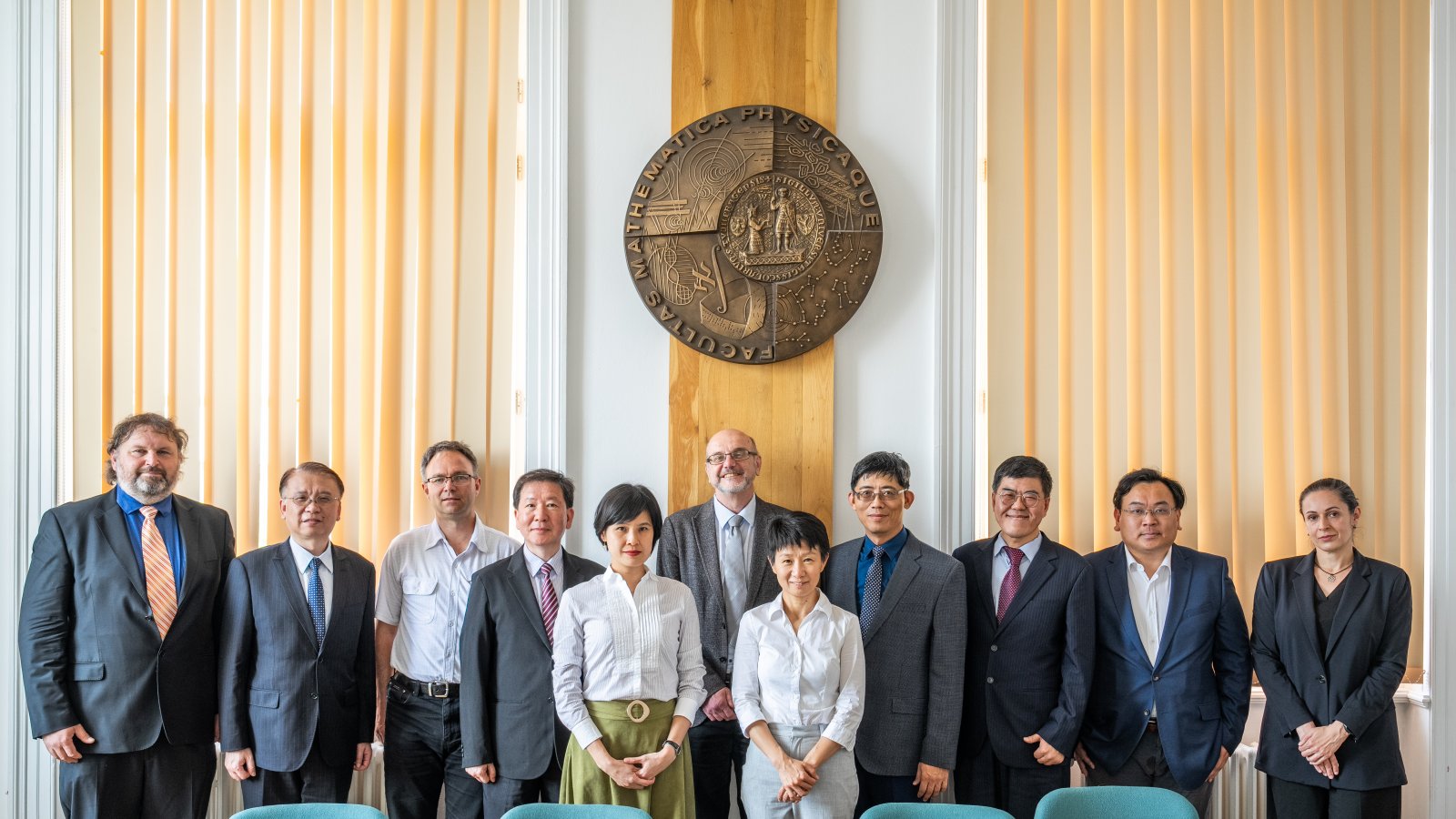
This project “Chirality and Spin Control in Advanced Two-Dimensional Optoelectronics” (International Integrated Collaboration Project for Interested Czech University (ICU) & University Academic Alliance in Taiwan (UAAT)) aims to deliver optoelectronic devices built from stacked two-dimensional (2D) materials that combine diverse physical properties, enabling multifunctional behavior and unique interlayer phenomena. The polarization of incident light is closely linked to the spin polarization of transported electrons, revealing fundamental correlations between light and matter. These novel effects at 2D heterointerfaces not only deepen our scientific understanding but also open new avenues for designing next-generation, sub-nanometer optoelectronic semiconductors. This Taiwan–Czech collaborative initiative brings together complementary expertise in optoelectronics, spintronics, nanodevices, and surface science to advance van der Waals heterojunction research while fostering the next generation of scientists. Joint efforts will include collaborative experiments using advanced characterization techniques, integration of results, researcher and student exchanges, and specialized workshops and conferences in fields such as Raman spectroscopy and spintronics. By strengthening international collaboration and nurturing young talent, the project aims to drive innovation and contribute to future breakthroughs in 2D material science and technology.
-
Principal Investigator
prof. Jana Kalbáčová Vejpravová -
Team
1 professor, 1 associate professors, 2 postdocs, 2 PhD students, 2 technicians (FMP only) -
Duration
2024+, periodis extensions -
Research area
Materials research for Key Enabling Technologies

prof. Jana Kalbáčová Vejpravová
Principle investigator
Current position: Full Professor, Head of Physics of Nanostructures Group
Main field: Condensed matter physics
Fields of interest and expertise: Physics of quantum and low-dimensional materials; low-temperature physics; magneto-optics
Role of MGML in the Project
MGML instruments are utilized for high-resolution structural characterization of materials and for advanced physical measurements under extreme conditions, including electronic transport, magnetic, and magneto-optic responses. Within the framework of the project, operando experiments in cryomagnetic environments are being developed in close collaboration with MGML to enable real-time probing of material properties. In addition, MGML provides a comprehensive training platform for students and early-career researchers from Taiwan, offering hands-on experience with state-of-the-art techniques and methodologies.